From Agents to Agency: Rethinking Human Agency in Agentic Visualization
Narges Mahyar (City St George’s, University of London), Mahmood Jasim (Louisiana State University), Niklas Elmqvist (Aarhus University), Ali Sarvghad (City St. Georges University London)

Links
Sign in to access the Paper PDF.
Abstract
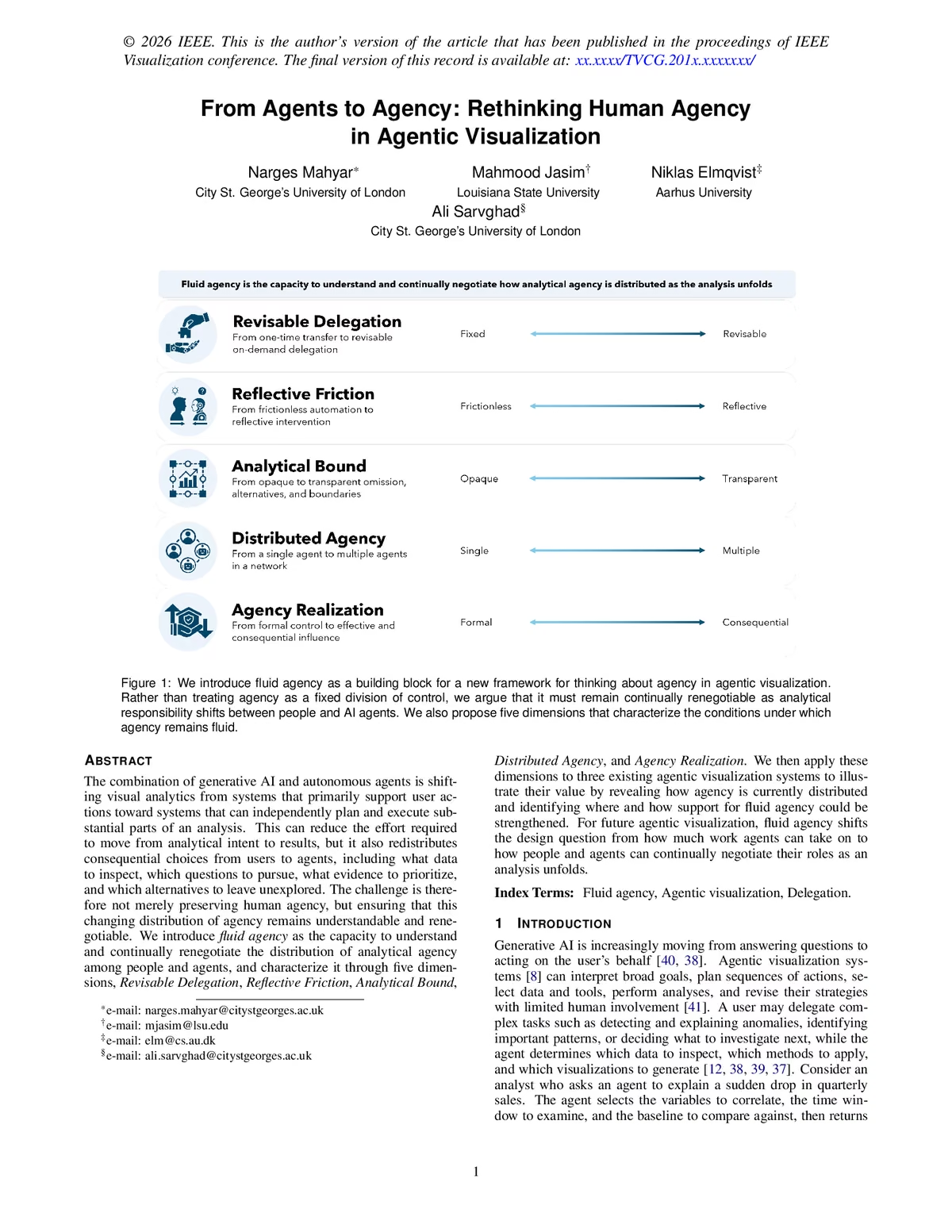
The combination of generative AI and autonomous agents is shifting visual analytics from systems that primarily support user actions toward systems that can independently plan and execute substantial parts of an analysis. This can reduce the effort required to move from analytical intent to results, but it also redistributes consequential choices from users to agents, including what data to inspect, which questions to pursue, what evidence to prioritize, and which alternatives to leave unexplored. The challenge is therefore not merely preserving human agency, but ensuring that this changing distribution of agency remains understandable and renegotiable. We introduce fluid agency as the capacity to understand and continually renegotiate the distribution of analytical agency among people and agents, and characterize it through five dimensions, Revisable Delegation, Reflective Friction, Analytical Bound, Distributed Agency, and Agency Realization. We then apply these dimensions to three existing agentic visualization systems to illustrate their value by revealing how agency is currently distributed and identifying where and how support for fluid agency could be strengthened. For future agentic visualization, fluid agency shifts the design question from how much work agents can take on to how people and agents can continually negotiate their roles as an analysis unfolds.